Saturday, October 24, 2020

Mini-Forests To Aid Biodiversity

 Mini-Forests To Aid Biodiversity

Fast-growing mini-forests are catching the imagination of people to aid biodiversity.

Mini forest are based on the work of the Japanese botanist Akira Miyawaki, who has planted more than 1,000 such forests in Japan, Malaysia and elsewhere. Miyawaki forests are denser and said to be more biodiverse than other kinds of woods.

  • The Miyawaki method, also called the Potted Seedling Method, is an afforestation technique that uses native species to create dense, multilayered forests.
  • A central tenet in creating these forests is its use of indigenous species for plantations.
  • The overall density of the forest is beneficial in lowering temperature, making soil nutritious, supporting local wildlife and sequestration of carbon.


Mini forests can be as small as a tennis court. Advocates for the method say the miniature forests grow 10 times faster and become 30 times denser and 100 times more biodiverse than those planted by conventional methods. This result is achieved by planting saplings close together, three per square meter, using native varieties adapted to local conditions. A wide variety of species – ideally 30 or more – are planted to recreate the layers of a natural forest.

Natural forests can store 40 times more carbon than single-species plantations. They regenerate land in far less time than the 70-plus years.

The mini-forests could attract migratory songbirds. “Songbirds are made from caterpillars and adult insects, and even small pockets of forests, if planted with native species, could become a nutritious fast-food fly-in site for hungry birds.”

The higher biodiversity is due partly to the forests’ young age and openness. This allows more sunlight to reach flowering plants that attract pollinators. Diversity is also boosted by planting multiple species, which “provide more variety in food and shelter for a higher diversity of animals like insects, snails, butterflies, amphibians, bugs, grasshoppers”,.

Tiny, dense forests are springing up around Netherlands, France & Belgium as part of a movement aimed at restoring biodiversity and fighting the climate crisis.

Mini-Forests To Aid Biodiversity
Miyawaki Forest Bangaluru


Friday, October 23, 2020

Globalization Was Wrong

Trade Experts Admit They Were Wrong About Globalization


Paul Krugman and other mainstream trade experts are now admitting that they were wrong about globalization.

The Nobel Prize-winning Krugman branded just about everybody who questioned the rapid pace of globalization a fool who didn’t understand economics very well. “Silly” was a word Krugman used a lot to describe pundits who raised fears of economic competition from other nations, especially China. Don’t worry about it, he said: Free trade will have only minor impact on your prosperity.

Now Krugman has come out and admitted, offhandedly, that his own understanding of economics has been seriously deficient as well. In a recent essay titled “What Economists (Including Me) Got Wrong About Globalization,” adapted from a forthcoming book on inequality, Krugman writes that he and other mainstream economists “missed a crucial part of the story” in failing to realize that globalization would lead to “hyperglobalization” and huge economic and social upheaval, particularly of the industrial middle class in America. And many of these working-class communities have been hit hard by Chinese competition, which economists made a “major mistake” in underestimating, Krugman says.

He has also become a leading and sometimes harsh critic of his own profession, especially in the aftermath of the financial crisis and Great Recession, when he declared that much of the past 30 years of macroeconomics was “spectacularly useless at best, and positively harmful at worst.”

 “I’m glad he’s finally seen the light on trade,” Reich told me in an email. Krugman, in another email, wrote: “I regret having said that about Reich, but if he foresaw hyperglobalization or the localized effects of the China shock, that’s news to me.”

Yet it has taken an awful long time for economists to admit that their profession has been far too sure of itself

As the journalist Binyamin Appelbaum writes in his book, The Economists’ Hour: False Prophets, Free Markets, and the Fracture of Society, economists came to dominate policymaking in Washington in a way they never had before and, starting in the late 1960s, seriously misled the nation, helping to disrupt and divide it socially with a false sense of scientific certainty about the wonders of free markets. The economists pushed efficiency at all costs at the expense of social welfare and “subsumed the interests of countrymen (Americans) as producers to the interests of countymen (Americans)  as consumers, trading well-paid jobs for low-cost electronics.

Part of the problem is that, back in the ’90s, when the post-Cold War consensus was just emerging, economists tended to take a simplistic either-or view of trade—either you were a free trader or a protectionist—and forced people to choose sides.

Indeed, those who advocated anything resembling government interference in markets and “fair trade” (more tariffs, unemployment insurance, and worker protections) over “free trade” were usually branded protectionists and excluded from the debate.

https://getpocket.com/explore/item/economists-on-the-run

Sunday, October 11, 2020

Save Paper n' Trees At Home & Office


How to save paper and trees @ home & office

Remember how excited we were when offices were computerised and the idea of a 'paperless office' was considered fashionable? Alas! Instead of decreasing the amount of paper that businesses handle, technology has made it easier to create more paper trails than ever before.

No longer do you have to painstakingly write... just print, print and print!

Whether we realise it or not, paper plays a very important role in our lives. We come across it every day numerous times. It's almost omnipresent. The newspaper, cereal box, the shopping bag, the tissue, the toilet paper, books, magazines, labels, it's everywhere.

When paper is such an intense part of our lives and we know trees need to be cut down to make it, why not be a little more judicious before we hit the print key?

Making a difference

There are people who are doing their bit to save paper in their own small ways. 'We lived abroad for over 3 years and we would read our Indian newspapers online,' says Geetha Balasubramanian. 'Now it's become a habit. When we moved back to India in 2007, we continued reading the epaper version,' she adds.


Epapers is something we can easily take up. In most cases we just flip through the paper and read just about two articles before putting it away. Why not do that over the net?

Then there is Gunjan Verma who keeps all the wrapping paper from the gifts her children get. 'It sounds miserly but I really did it to save paper. If it's good and reusable why throw it away?' she asks. What's more Gunjan's daughters made a sturdy paper bag for her shopping with all the junk mail they got in their letterbox. 'If we have to teach our children about how to conserve resources we have to get involved now,' she believes.


Here are some tips that can help you be a conscious citizen and save paper.

In the office:

* Print only when it is absolutely necessary. And promote a 'think before you print' attitude.
* Set computer defaults to print double-sided.
* Proof read documents on screen before printing. You don't want to reprint pages because of errors that could have been avoided.
* Print addresses directly on envelopes and avoid using labels.
* Fill copier trays correctly to avoid paper jams.
* While buying paper or diaries, stick to recycled paper with a high percentage of post-consumer recycled content.
* Opt for uncoloured paper and buy in bulk to reduce packaging.
* Encourage reusing paper that has been printed only on one side.
* Trim mailing lists used to send information to your customers to avoid unwanted and duplicate mailing.
* Change the paper cups in the pantry with ceramic stuff that can be washed and put back on the shelf.
* Use the fastest and paperless way to mail documents -- email.
* Reuse cardboard shipping boxes. Shipping boxes can be reused many times.
* Send wastepaper for recycling.


At home:

* If you can, stop buying the newspaper and read the epaper instead.
* Get your name off mailing lists that send you promotions you don't care about.
* Opt for e-bil options with your phone, electrictity service providers.
* Get washable cloth towels for the kitchen and cut down on paper towel usage.
* Teach children not to tear paper from notebooks to make airplanes.
* If you enjoy reading, join a library rather than buying books.
* Make the kabadiwala a friend and give wastepaper for recycling.
* Switch to recycled toilet paper.
* Don't accept promotional fliers as they are going to go straight into the bin.

Kyoto Protocol


Kyoto Protocol


The Kyoto Protocol is an international agreement linked to the United Nations Framework Convention on Climate Change. The major feature of the Kyoto Protocol is that it sets binding targets for 37 industrialized countries and the European community for reducing greenhouse gas (GHG) emissions .These amount to an average of five per cent against 1990 levels over the five-year period 2008-2012.


Delegates celebrated adoption of the Protocol in 1997.


he major distinction between the Protocol and the Convention is that while the Convention encouraged industrialised countries to stabilize GHG emissions, the Protocol commits them to do so.

Recognizing that developed countries are principally responsible for the current high levels of GHG emissions in the atmosphere as a result of more than 150 years of industrial activity, the Protocol places a heavier burden on developed nations under the principle of “common but differentiated responsibilities.”

The Kyoto Protocol was adopted in Kyoto, Japan, on 11 December 1997 and entered into force on 16 February 2005. The detailed rules for the implementation of the Protocol were adopted at COP 7 in Marrakesh in 2001, and are called the “Marrakesh Accords.”

The Kyoto mechanisms

Under the Treaty, countries must meet their targets primarily through national measures. However, the Kyoto Protocol offers them an additional means of meeting their targets by way of three market-based mechanisms.

The Kyoto mechanisms are:

·    Emissions trading – known as “the carbon market"

·    Clean development mechanism (CDM)

·    Joint implementation (JI).

The mechanisms help stimulate green investment and help Parties meet their emission targets in a cost-effective way.

Monitoring emission targets

Under the Protocol, countries’ actual emissions have to be monitored and precise records have to be kept of the trades carried out.

Registry systems track and record transactions by Parties under the mechanisms. The UN Climate Change Secretariat, based in Bonn, Germany, keeps an international transaction log to verify that transactions are consistent with the rules of the Protocol.

Reporting is done by Parties by way of submitting annual emission inventories and national reports under the Protocol at regular intervals.

A compliance system ensures that Parties are meeting their commitments and helps them to meet their commitments if they have problems doing so.

Adaptation
The Kyoto Protocol, like the Convention, is also designed to assist countries in adapting to the adverse effects of climate change. It facilitates the development and deployment of techniques that can help increase resilience to the impacts of climate change.

The Adaptation Fund was established to finance adaptation projects and programmes in developing countries that are Parties to the Kyoto Protocol. The Fund is financed mainly with a share of proceeds from CDM project activities.

The road ahead

The Kyoto Protocol is generally seen as an important first step towards a truly global emission reduction regime that will stabilize GHG emissions, and provides the essential architecture for any future international agreement on climate change.

By the end of the first commitment period of the Kyoto Protocol in 2012, a new international framework needs to have been negotiated and ratified that can deliver the stringent emission reductions the Intergovernmental Panel on Climate Change (IPCC) has clearly indicated are needed.

1.   Emissions Trading


Greenhouse gas emissions – a new commodity


Parties with commitments under the Kyoto Protocol (Annex B Parties) have accepted targets for limiting or reducing emissions. These targets are expressed as levels of allowed emissions, or “assigned amounts,” over the 2008-2012 commitment period. The allowed emissions are divided into “assigned amount units” (AAUs).

Emissions trading, as set out in Article 17 of the Kyoto Protocol, allows countries that have emission units to spare - emissions permitted them but not "used" - to sell this excess capacity to countries that are over their targets.
Thus, a new commodity was created in the form of emission reductions or removals. Since carbon dioxide is the principal greenhouse gas, people speak simply of trading in carbon. Carbon is now tracked and traded like any other commodity. This is known as the "carbon market."


Other trading units in the carbon market


More than actual emissions units can be traded and sold under the Kyoto Protocol’s emissions trading scheme.

The other units which may be transferred under the scheme, each equal to one tonne of CO2, may be in the form of:

·    A removal unit (RMU) on the basis of land use, land-use change and forestry (LULUCF) activities such as reforestation

·     An emission reduction unit (ERU) generated by a joint implementation project

·    A certified emission reduction (CER) generated from a clean development mechanism project activity

Transfers and acquisitions of these units are tracked and recorded through the registry systems under the Kyoto Protocol.
An international transaction log ensures secure transfer of emission reduction units between countries.


The commitment period reserve


In order to address the concern that Parties could "oversell" units, and subsequently be unable to meet their own emissions targets, each Party is required to maintain a reserve of ERUs, CERs, AAUs and/or RMUs in its national registry. This reserve, known as the "commitment period reserve", should not drop below 90 per cent of the Party's assigned amount or 100 per cent of five times its most recently reviewed inventory, whichever is lowest


Relationship to domestic and regional emissions trading schemes


Emissions trading schemes may be established as climate policy instruments at the national level and the regional level. Under such schemes, governments set emissions obligations to be reached by the participating entities. The European Union emissions trading scheme is the largest in operation.


2.   Clean Development Mechanism (CDM) 


The Clean Development Mechanism (CDM), defined in Article 12 of the Protocol, allows a country with an emission-reduction or emission-limitation commitment under the Kyoto Protocol (Annex B Party) to implement an emission-reduction project in developing countries. Such projects can earn saleable certified emission reduction (CER) credits, each equivalent to one tonne of CO2, which can be counted towards meeting Kyoto targets.

The mechanism is seen by many as a trailblazer. It is the first global, environmental investment and credit scheme of its kind, providing a standardized emissions offset instrument, CERs.

A CDM project activity might involve, for example, a rural electrification project using solar panels or the installation of more energy-efficient boilers.

The mechanism stimulates sustainable development and emission reductions, while giving industrialized countries some flexibility in how they meet their emission reduction or limitation targets.


Operating details of the CDM


A CDM project must provide emission reductions that are additional to what would otherwise have occurred. The projects must qualify through a rigorous and public registration and issuance process. Approval is given by the Designated National Authorities. Public funding for CDM project activities must not result in the diversion of official development assistance.

The mechanism is overseen by the CDM Executive Board, answerable ultimately to the countries that have ratified the Kyoto Protocol.

Operational since the beginning of 2006, the mechanism has already registered more than 1,650 projects and is anticipated to produce CERs amounting to more than 2.9 billion tonnes of CO2 equivalent in the first commitment period of the Kyoto Protocol, 2008–2012. 

For up-to-date information on the CDM, see the UNFCCC CDM website.


3.   Joint Implementation (JI)


The mechanism known as “joint implementation,” defined in Article 6 of the Kyoto Protocol, allows a country with an emission reduction or limitation commitment under the Kyoto Protocol (Annex B Party) to earn emission reduction units (ERUs) from an emission-reduction or emission removal project in another Annex B Party, each equivalent to one tonne of CO2, which can be counted towards meeting its Kyoto target.

Joint implementation offers Parties a flexible and cost-efficient means of fulfilling a part of their Kyoto commitments, while the host Party benefits from foreign investment and technology transfer.

Eligibility and approval

A JI project must provide a reduction in emissions by sources, or an enhancement of removals by sinks, that is additional to what would otherwise have occurred.  Projects must have approval of the host Party and participants have to be authorized to participate by a Party involved in the project.

Projects starting as from the year 2000 may be eligible as JI projects if they meet the relevant requirements, but ERUs may only be issued for a crediting period starting after the beginning of 2008.


Track 1 and Track 2 procedures


If a host Party meets all of the eligibility requirements to transfer and/or acquire ERUs, it may verify emission reductions or enhancements of removals from a JI project as being additional to any that would otherwise occur. Upon such verification, the host Party may issue the appropriate quantity of ERUs. This procedure is commonly referred to as the “Track 1” procedure.”

If a host Party does not meet all, but only a limited set of eligibility requirements, verification of emission reductions or enhancements of removals as being additional has to be done through the verification procedure under the Joint Implementation Supervisory Committee (JISC). Under this so-called “Track 2” procedure, an independent entity accredited by the JISC has to determine whether the relevant requirements have been met before the host Party can issue and transfer ERUs.

A host Party which meets all the eligibility requirements may at any time choose to use the verification procedure under the JISC (Track 2 procedure).

For up-to-date information on JI, see the UNFCCC JI website.

Wednesday, October 7, 2020

Remote Working Works

 Remote Work Works—Where Do We Go from Here?

COVID-19 has shown us what organizations can accomplish. Just days after the illness caused by the novel coronavirus was officially labeled a pandemic, many had managed to get more than 90% of their staff working remotely. Jobs that we never imagined could be performed remotely—like call center operator, financial trader, and many more—suddenly and successfully were handled from home. Now, in many places, pandemic-associated restrictions are easing and companies are turning their attention to bringing people back to the workplace.

The obvious and immediate question for many organizations is, “How can we safely bring employees back to the workplace?” But leaders must expand their thinking when considering the work environment of the future. Because the rabbit is out of the hat: remote working works, and it has obvious benefits. (See Exhibit 1.) We can’t help but wonder what role it should continue to occupy. It’s imperative to start with a clean slate and reconfigure the “workplace” of the future. We urge organizations to stop and reflect before bringing any workers (beyond the first wave of critical returnees) back and instead pause to set a long-term ambition for the future of work. 

SETTING THE LONG-TERM AMBITION

Many leaders are indeed taking a long-term view and asking themselves what’s next for remote work within their organization. BCG’s recent Workplace of the Future survey reveals that most organizations believe their future workforce will be much more remote than ever before:

  • Overall, companies expect approximately 40% of employees to utilize a remote working model in the future.
  • Thirty-seven percent of companies expect that more than 25% of employees will work in hybrid models that combine remote and onsite work.


(The Workplace of the Future survey focuses on employee roles and jobs that are not heavily dependent on work sites or plants, such as retail stores, manufacturing sites, and select service sectors; these roles and jobs are addressed in “Restarting Work Safely and Under Control.”)

It is clear that remote work will grow in the future, but it is up to leadership to set a bold yet sustainable vision for how that will happen. Here’s how to shape that vision.

Consider multiple versions of “remote.” Remote work doesn’t have to mean that all or most employees always work from home. Remote work can be structured so that employees split their time between home and the workplace, on alternate weeks and on a rotating schedule. It can include designated times for everyone to be physically present—for instance, there might be good reason for everyone to be on site on, say, Wednesdays or throughout the first week of every month. Or a company could choose a work-from-anywhere model in which employees can work remotely all the time but still be able to visit any work location anytime, if they wish to do so for the purpose of affiliation. (See Exhibit 2.)

Take a job-by-job or function-by-function approach. Because jobs differ, the need for collocation differs too. Consider the nature of the work (some jobs or functions require in-office equipment), the need for interaction (for live supervision or brainstorming, for instance), and so on.  

Mapping jobs and functions to various models of remote work will help to crystallize the opportunity for each group and geographic area and to determine which work and workers can be remote for the foreseeable future and which should be collocated. To do this, organizations should consider five key characteristics of work. Indeed, we use this set of drivers when diagnosing remote opportunities for our clients. Building from that examination, teams and functions within companies must consider how they would choose to apply remote, onsite, or hybrid working models given their specific day-to-day needs and unique environment.

  • Onsite Client Interaction. Consider the degree to which each individual job requires an employee to interact live with customers. Take into account customer migration during the pandemic and whether customers will stay virtual. Relevant jobs include face-to-face sales roles and receptionists.
  • Specialized Equipment and Facilities.  To what degree does a particular job require the use of certain onsite equipment or facilities? This is a particular consideration for manufacturing and worksite management roles, among others.
  • Supervision and Regulatory Oversight. Some jobs require close supervision from a superior, given the importance of accuracy in the work performed or because regulatory requirements make this the best practice. Auditor and data specialist roles are among the jobs that could fall into this category.
  • Collaboration and Interaction. Think about how much collaboration or interaction with other employees is required, whether in the same job function or across functions. Project managers and operations leads are examples of jobs likely to emphasize collaboration and interaction.
  • Innovation. How important is innovation in a particular role? Does it tend to result in better outcomes? Given jobs where this might be a consideration include engineering roles and marketing specialists.

(It’s important to note, though, that many remote teams have effectively collaborated and innovated during the pandemic.)
With a role-by-role consideration of multiple versions of hybrid work, organizations can be ambitious about their future approach. They can also  experiment with different models and support during the prevaccine time period.  This will enable them to get better at remote work today and set the ultimate ambition for tomorrow.


ENSURING TOMORROW’S REMOTE SUCCESS TODAY

A remote-working ambition is a step toward reenvisioning what work can and should be in the future. But that ambition does not always ensure remote success now without proper planning. In every organization, remote working is functioning well in some areas and not so well in others. There’s a lot to be learned from the successes. Remember: the shift to remote work happened in a matter of days or weeks and required people to use new digital tools that they weren’t necessarily comfortable with. Absent training, coaching, and time to learn all the tricks, it was trial by fire. Some mastered the shift better than others. As restrictions fall in this prevaccine time, we can and should assess multiple hybrid models that mix remote and onsite work and learn from recent experience.

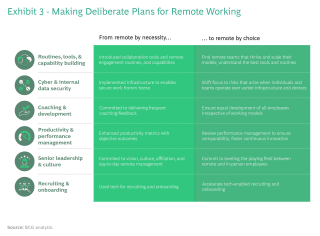
Tackling the complexity presented by hybrid models by choice will be much more challenging than the initial shift to full remote for nonessential workers, which was an act of necessity. Paying attention to core needs across six domains can ensure the effectiveness of remote working. (See Exhibit 3.)

Routines, Tools, and Capability Building. At the brink of the pandemic, organizations rushed to provide new collaboration tools and working routines that would enable their employees to rapidly adapt to working from home. But did these tools and routines succeed?

It is time to assess what worked and what didn’t. Were Zoom breakout rooms better than collaboration tools like Trello, for instance? Identifying and understanding how and why certain tools are being used (or are not being used) will allow teams to address issues. Studying highly effective teams and their behaviors, routines, and use of tools can help managers across the organization scale best practices across teams. What capabilities—specific knowledge, skills, and attitudes—do these employees and leaders have? How can the organization enable them to teach others? Rarely do tools alone suffice. People need to undertake deliberate practice to build new habits and muscles to get the full value of any change.

Cybersecurity and Internal Data Security. If employees are working from home on unsecured networks, the risk of external cyber threats is increased, which means that organizations will need more cybersecurity experts. This need will grow as more employees work in a hybrid environment; unpredictable environments increase the risk of security breaches.

Additionally, the limited supervision of remote workers, even for critical tasks, heightens the company’s vulnerability to data security issues internally. To reduce data security risk, companies must ensure that they restrict access to sensitive information to select employees, institute data access expirations, implement multistep (and multiperson) approval processes for any information sharing, and limit access to sensitive information to certain working hours. Only 30% of cybersecurity is technology. The other 70% is culture, behavior, and awareness. Developing programs to build a cyber- and data-secure culture must be on the immediate priority list.

Coaching and Development. Informal coaching moments that might have happened at the end of meetings have given way to quick transitions from one call to the next. Teams and leaders need to make time to give feedback for the sake of coaching and development. They need to find moments of spontaneity to check in with colleagues.

Leaders must also ensure that they dedicate comparable attention to onsite and remote employees.

There is also a clear need to ensure that teams continue to grow and learn during these times, given the rapid-fire rate of change and the focus on execution. It is important that leaders adjust their thinking and be deliberate and thoughtful when coaching their staff and each other.

Productivity and Performance Management. Being present is not the same as being effective and productive. Companies may have implicitly married presence to performance in the past, but they have been forced to change this notion in the new remote environment. Remote work has helped move performance metrics from inputs to outputs. For roles that do not have quantitative output measures, companies like Apple and USAA have leveraged net promoter scores from internal customers to serve as important measures of productivity.

Effectively measuring productivity is just a single piece in the broader performance management puzzle. Companies must recognize that the daily tasks and performance targets of many roles have changed dramatically as a result of the pandemic-induced workplace shifts. One key to performance management will be adjusting productivity and performance expectations to align with changing roles and updated company performance goals that come with the shifting economic and social environment.

Leaders must also institute a process for reviewing how promotions, bonuses, and overall performance scores compare across remote and onsite employees. Introducing this process will ensure that employees are evaluated and rewarded in a comparable manner.

Senior Leadership and Culture. In the face of COVID-19, organizations came together and acted swiftly and across boundaries to get things done. That positive culture should be sustained. Companies can also treat this time of flux as an opportunity to eliminate lingering negative aspects of the past culture: face time, hierarchy, personal connections, and lack of diversity.

With everyone working remotely, leaders have had to find new ways to connect and build virtual social intimacy. Those efforts have paid off. COVID-19 has leveled the playing field for remote and flex workers. They no longer struggle to have their voices heard in a meeting or miss out on hallway chatter and the social bonding that happens before and after meetings. The relationship between company leaders and the workforce is different now too. Leaders are no longer in their intimidating executive suites. They are on screen from home, with kids and pets in the background and needing haircuts just like everyone else.

To reap the benefits of remote work, leaders must take action to maintain and even improve the positive culture. They should model the change and work remotely as well, using a hybrid model. For instance, they might work remotely for two days a week. Organizations are looking to the C-suite more than ever.  

Recruiting and Onboarding. Tomorrow’s workforce is just as important as today’s. While it is natural for leaders to spend a large majority of their time thinking about how best to position their existing employees for success in remote settings, they must not lose track of how to adjust the recruitment and onboarding of new employees in a remote setting.

For recruiting, HR leaders can accelerate tech-enabled recruiting methods, such as video interviewing, automated resume review, and gamified evaluations. For onboarding, companies need to determine what a remote “day 1” and “onboarding week” will entail. Virtual coffee chats, welcome videos with greetings from current employees, and virtual networking can work wonders to foster engagement and immediate buy-in.

No matter the recruiting and onboarding approach taken, leaders must be sure that best practices are shared across the organization to enable a standardized approach and clear expectations moving forward.


The abrupt and forced transition to remote work was, by all accounts, a big success. Why stop there? Even though restrictions are lifting, organizations do not need to return to all of their old ways of working. Rather than taking a “yesterday, forward” approach that resets the clock to pre-COVID-19 days and reseats all employees at their onsite work stations, organizations can choose a “tomorrow, backward” philosophy that embraces a future built on the lessons of these last few months of remote working. From that foundation, organizations can establish a deliberate future for remote, onsite, and hybrid working models in ways that deliver the greatest value.


https://www.bcg.com/publications/2020/remote-work-works-so-where-do-we-go-from-here?

Economists Have Moved Leftward

  Post Globalisation Economists Have Moved Leftward in America. Others may soon follow. Paul Krugman t he Nobel Prize-winning economist ha...